LOCATION: Simondium / Franschhoek
LEADER: John Rennie & Pat Kramer
We will be visiting Franschhoek for our first outing of the year.
Our first stop is Simondium where we will be looking at the old station building designed by Sir Herbert Baker who was influenced by local vernacular architecture.
Cecil John Rhodes was a friend and patron of Sir Herbert Baker, designer of the Union Buildings and Pretoria station among his many achievements in South Africa and co-designer with Lutyens of the Imperial seat of government in Delhi that Sir Herbert also designed the humble station buildings of Simondium, a halt that served Rhodes’s fruit farms!
In the old cover photograph, the stationmaster, his wife and children, the train personnel and an arriving customer (perhaps a taxi) with his Cape cart provide this glimpse of rural Edwardian life as the evening mixed train from Franschhoek calls at Simondium c1912.
Franschhoek – Huguenot Memorial Museum
We will be visiting the museum to see the exhibition (opened in April 2019) that curator Tracey Randle spoke about at the February Talk. Those of you who attended the Tracey’s talk will have a good understanding of the reinterpretation and method of display.
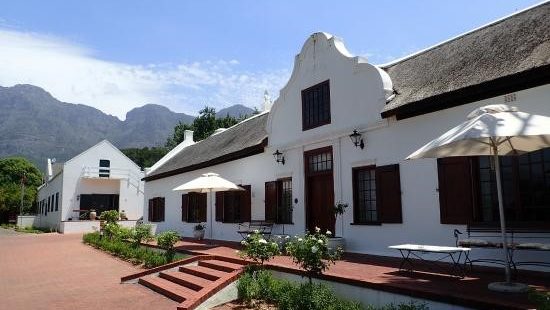
Bien Donné was granted to Pierre Lombard, a Huguenot. In 1762 it was transferred to Jan de Villiers, the owner of Boschendal and in 1777 to his son David. The homestead was built by him in 1800. In 1806 his widow transferred the farm to Daniel Joubert, who was a relative.
The H-shaped house was ‘restored’ by FK Kendall in 1929 (He also reconstructed Groot Constantia after the fire.) The entrance was shifted to the rear of the property in the 1830s and it has a mock door. The house was later restored by the architect Revel Fox. The cellar is dated 1792.
After lunch, we will make our way to Plaisir de Merle – a complete contrast to Bien Donné. In 1693 the Cape Governor, Simon van der Stel, granted the Huguenot, Charles Marais, land, which he named after his home town, Le Plessis Marly. Today the farm is known as Plaisir de Merle which translates from the French to ‘Pleasure of the Blackbird’
The homestead was built by Jacob Marais in 1764, although there probably was a longhouse there before. The cellar is dated 1823, probably by Daniel Hugo who held the farm from 1808 until 1848.